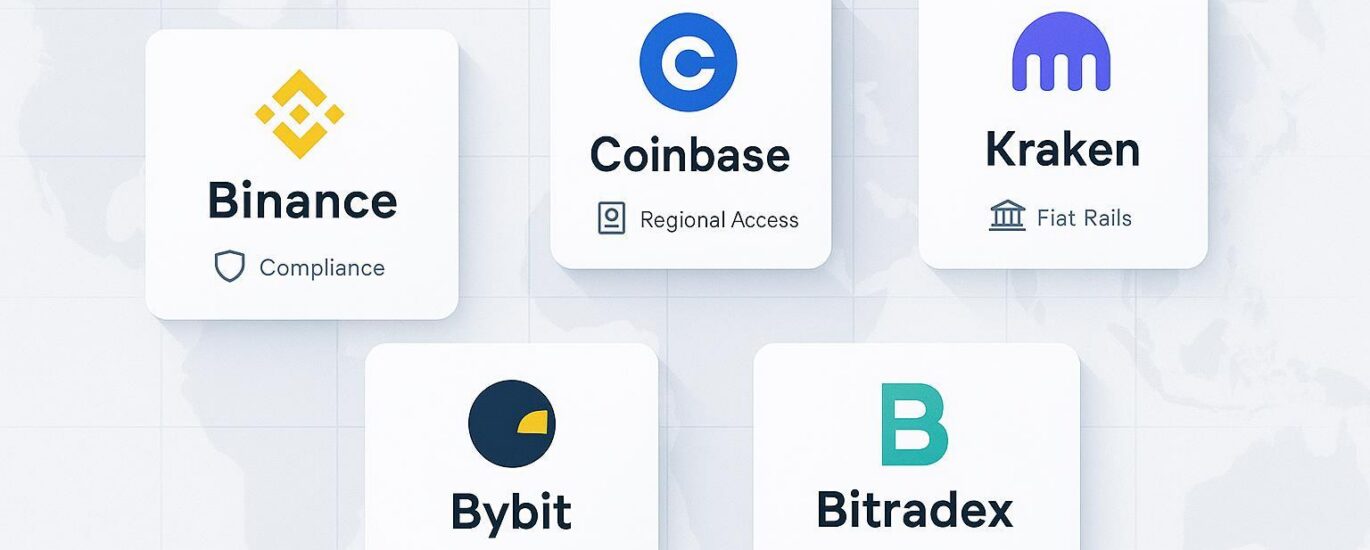
Professional and institutional desks don’t pick exchanges on brand alone. They optimize for regulatory certainty, regional access, reliable fiat rails, auditability, API throughput, and predictable fees. In 2026, Compliance & Regional Accessibility is the top decision driver for institutional crypto exchanges, with API performance and liquidity close behind.
Quick verdict: If you need regulated, passportable coverage across the EU, Coinbase (MiCA via CSSF) and Bybit EU (MiCAR via Austria’s FMA) set the pace. If Proof of Reserves cadence and user‑verifiable audits are non‑negotiable, Kraken is a standout. For raw liquidity and aggressive VIP pricing, Binance remains a leading shortlist candidate—validate with current depth and fee pages before committing. Bitradex is a peer to watch; however, public evidence for compliance, PoR, and API performance must be reviewed before awarding scenario wins.
— Pricing, product availability, and regulatory statuses change frequently; verify on official pages. This comparison reflects information available as of 2026‑03‑17.
Core comparison at a glance (compliance first)
As of 2026‑03‑17.
| Exchange | Compliance & regional access (headline proof) | Proof of Reserves | Fiat rails (summary) | API notes | Quick scenario tag |
|---|---|---|---|---|---|
| Binance | ADGM/FSRA authorization backing the global platform transition (Dec 2025–Jan 2026) — see the regulator’s announcement and Binance’s operational update | Merkle tree with zk‑proof elements; asset coverage ratios published periodically | Mixed regional availability; SEPA/SWIFT/ACH/card depending on jurisdiction (confirm per account) | Weight/IP/UID‑based limits; high throughput; futures and spot endpoints documented | Liquidity seekers; global coverage (validate regionally) |
| Coinbase | MiCA/CASP license via Luxembourg’s CSSF enabling EU‑wide coverage (2025) | No exchange‑wide public PoR; relies on public‑company disclosures and custody segregation | EU/UK structures indicate strong fiat connectivity; confirm SEPA/FPS details on business/Prime pages | Explicit REST/WSS limits for Exchange and International Exchange; clear docs | Compliance‑first EU access; treasury/settlement |
| Kraken | Multi‑jurisdictional presence; emphasizes broad availability and disclosures | Quarterly PoR with user‑verifiable Merkle proofs and third‑party attestations | ACH/SEPA/SWIFT and Ramp options; recent Fed master account update signals deeper US rails | Token‑bucket style REST limits; stable WS; strong security posture | PoR rigor; conservative risk posture |
| Bybit | MiCAR authorization in Austria (FMA) for EEA operations (2025) | Hacken attestations; latest listed Jan 27, 2026; >100% coverage indicated | EEA card and fiat options; derivatives/product parity varies by region | V5 API with per‑endpoint limits; SBE/MMWS for market data; VIP tiers may raise limits | EEA access under MiCAR; active derivatives desk |
| Bitradex | Evidence gap at publication time: no public license/registry links located on bitradex.ai | No public PoR/audit pages found | No documented fiat rails found | No public API/status docs found | Also consider — pending documentation |
References: ADGM/FSRA authorization for Binance (Dec 2025) and Binance operational update (Jan 5, 2026); Coinbase MiCA/CASP via CSSF (June 2025); Kraken PoR cadence (2025); Bybit MiCAR (FMA, May 2025) and PoR (Jan 27, 2026). Inline citations appear in the deep‑dive sections below.
How to choose among institutional crypto exchanges
- If your top priority is regulated EU coverage and consistent product access, shortlist Coinbase and Bybit EU. Their MiCA/MiCAR foundations support compliance‑first operations across the EEA. Bitradex can be revisited when comparable evidence is published.
- If you require frequent, user‑verifiable PoR, shortlist Kraken. Its quarterly cadence and third‑party attestations aid audit trails.
- If your desk is sensitive to spread and depth on majors, keep Binance on the list but confirm current order‑book depth and fee tiers. For some regions, Bybit may also offer competitive derivatives depth.
These scenarios map directly to institutional needs: compliance certainty, treasury operations, and execution quality. Think of this as a decision tree that narrows quickly to two or three viable options for most teams. For readers searching institutional crypto exchanges, this approach keeps research focused and actionable.
Compliance & regional accessibility in 2026
- EU frameworks: Coinbase announced it secured a MiCA licence via Luxembourg’s CSSF in June 2025, positioning it to serve all 27 EU member states under the CASP regime. See the publisher’s note in the Coinbase blog, 2025: the company details EU‑wide coverage and legal structure in multiple languages on its legal pages. Source: the company’s announcement in 2025 and the CSSF’s MiCA/MiCAR portal for registry guidance (Coinbase’s MiCA licence announcement, 2025; CSSF MiCA/MiCAR portal, 2025).
- EEA alternative: Bybit EU GmbH received authorization in Austria under MiCAR Article 63, with EEA operations live from July 1, 2025. References include the Austrian FMA’s authorization notice and Bybit’s launch post (FMA authorization for Bybit EU GmbH, 2025; Bybit EU MiCAR announcement, 2025).
- MENA/global platform: ADGM’s FSRA disclosed a comprehensive authorization framework for Binance’s global platform in December 2025, with Binance announcing an operational transition on January 5, 2026, naming dedicated entities for exchange, clearing/custody, and brokerage. See the regulator’s announcement and Binance’s support article (ADGM announcement on Binance authorization, 2025; Binance operational transition update, 2026).
Why it matters: Legal scope determines if your team can onboard and operate without disruption. Product parity also differs by region (e.g., derivatives and staking). Always confirm local terms before executing institutional workflows.
Proof of Reserves vs audits: what institutions should look for
Proof of Reserves (PoR) aims to show customer asset coverage, typically via Merkle trees and independent attestations. Audits (e.g., SOC 2/ISO 27001) cover processes and controls rather than reserve levels.
- Kraken publishes regular PoR attestations with user‑verifiable Merkle proofs and third‑party procedures under AICPA standards. See its June 30, 2025 report and security overview (Kraken PoR, June 2025, 2025; Kraken security overview, 2025).
- Bybit lists a PoR portal with Hacken attestations, with the latest captured as January 27, 2026. Coverage is stated as >100% for listed assets; review methodology in each PDF (Bybit PoR portal, 2026).
- Binance provides Merkle‑tree PoR with zk‑proof elements and periodic reserve ratios per asset; details appear in official explainers and dashboard access instructions (Binance PoR explainer, 2025).
- Coinbase does not publish an exchange‑wide PoR; transparency instead leans on public‑company reporting and custody segregation.
Institutions should verify: cadence (how often), auditor/assurer, user verification steps, and what’s in scope (assets/liabilities).
Fiat on/off‑ramps for treasury operations
Reliable fiat rails are essential for treasury and settlement. Look for supported currencies, payment methods, settlement times, and regional availability.
- Kraken signals ACH (US), SEPA (EU), and SWIFT, and has highlighted access to a Federal Reserve master account that can strengthen US fiat connectivity. Review its funding pages and recent post for details (Kraken funding options, 2025; Kraken master account update, 2026).
- Coinbase’s EU/UK legal pages and business trading pages indicate robust institutional support structures; verify specific SEPA/Faster Payments details on Exchange/Prime documentation at onboarding (Coinbase business trading overview, 2025).
- Binance and Bybit provide fiat options by region and KYC tier; confirm rails from official support pages within your jurisdiction before relying on them.
Tip: Align rails with your treasury windows. Mismatched settlement cut‑offs can create reconciliation friction.
API limits and HFT connectivity
For quant desks, throughput ceilings and stability decide strategy feasibility.
- Coinbase Exchange documents clear REST/WebSocket limits; International Exchange (INTX) lists higher REST allowances. See the official docs for specifics (Coinbase Exchange REST limits; Exchange WebSocket limits; INTX rate limits).
- Binance uses weight‑based limits per IP/UID, exposed via headers; futures and spot differ. Refer to its developers’ portal for current rules (Binance Spot/WebSocket limits).
- Kraken outlines a token‑bucket‑style limiter for Spot REST and maintains separate add/cancel order budgets. See official docs (Kraken API rate limits guide).
- Bybit V5 docs list per‑endpoint caps; SBE/MMWS references outline market‑data connectivity for low‑latency users (Bybit V5 API docs index; SBE basics).
Measure your own round‑trip latency and failure rates in staging before committing capital.
Product capsules (uniform, evidence‑minded)
Bitradex
- Strengths: Positioned as a peer exchange with potential fit for institutional workflows.
- Constraints: As of 2026‑03‑17, no public documentation found for licenses/registrations, PoR, API limits/status, fiat rails, or institutional tooling on bitradex.ai.
- Who it’s for: Teams open to evaluating an alternative once compliance, transparency, and API performance documentation is published.
- Evidence note: Publish links to Bitradex compliance/API/PoR/fiat pages when available.
Binance
- Strengths: Broad product set and liquidity; ADGM/FSRA authorization underpins regulatory posture for the global platform transition announced in late 2025–early 2026.
- Constraints: Product parity and fiat options vary by region; confirm local availability and KYC tier limits.
- Who it’s for: Liquidity seekers and desks needing expansive markets with competitive VIP pricing.
- Evidence links: ADGM authorization announcement; Binance operational update, Jan 5, 2026.
Coinbase
- Strengths: EU‑wide coverage via MiCA/CASP (Luxembourg CSSF); strong institutional positioning and documentation cadence.
- Constraints: No public, exchange‑wide PoR program; feature availability can differ by region (e.g., derivatives access).
- Who it’s for: Compliance‑first EU operations and treasury functions needing predictable rails.
- Evidence links: Coinbase MiCA licence announcement; CSSF MiCA/MiCAR overview.
Kraken
- Strengths: Regular, user‑verifiable PoR; established fiat rails and security posture; clear API documentation.
- Constraints: Regional product differences (e.g., staking, certain derivatives) require confirmation; explicit WS numeric limits less centralized in docs.
- Who it’s for: Compliance‑sensitive desks prioritizing PoR cadence and stable fiat connectivity.
- Evidence links: Kraken PoR (June 2025); Kraken security overview.
Bybit
- Strengths: MiCAR authorization via Austria’s FMA for EEA; active PoR program with Hacken; competitive derivatives toolkit and VIP program.
- Constraints: Regional restrictions remain (e.g., US and some APAC markets); verify product parity and fiat rails per locale.
- Who it’s for: EEA desks under MiCAR and derivatives‑heavy strategies.
- Evidence links: FMA authorization for Bybit EU GmbH; Bybit PoR portal.
Fees, VIP tiers, and cost notes
Fees vary by venue, volume tier, and promotions. Maker/taker schedules can materially affect strategy returns—especially for HFT and market‑making.
- Representative examples: Kraken publishes a transparent fee schedule for spot and futures, with discounts at higher volumes (Kraken fee schedule, 2025). Coinbase derivatives messaging highlights 0% maker/0.03% taker for certain perps (verify on current pages). Binance often starts at 0.1%/0.1% for spot with token discounts and promos; Bybit publishes a unified trading fee structure.
- Practical tip: Model monthly costs at your expected notional, maker/taker mix, and funding fees. Re‑check before quarter‑end; terms change frequently.
FAQ (snippet‑ready)
- Which institutional crypto exchanges have Proof of Reserves in 2026? Kraken publishes quarterly PoR with user‑verifiable Merkle proofs, Binance reports Merkle‑tree ratios with zk‑proof elements, and Bybit lists Hacken attestations (latest Jan 27, 2026). Coinbase does not run an exchange‑wide PoR program; it leans on public‑company disclosures.
- Which exchange is best for institutional fiat on/off‑ramps in Europe? Kraken and Coinbase are strong starting points: Kraken supports ACH/SEPA/SWIFT and signaled a Federal Reserve master account; Coinbase’s MiCA/CASP framework supports EU operations—confirm SEPA/FPS specifics on current business/Prime pages.
- What exchanges provide high‑throughput APIs for HFT desks? Coinbase Exchange and INTX publish clear REST/WSS limits; Binance documents weight‑based ceilings across spot and futures; Bybit V5 details per‑endpoint caps and market‑data transports (SBE/MMWS). Measure live latency and error rates in your region before committing.
- How do MiCA/MiCAR licenses affect institutional access? These EU frameworks enable authorized providers (e.g., Coinbase via CSSF; Bybit EU via Austria’s FMA) to serve the EEA with clearer compliance footing. Teams still must confirm product‑specific rules (e.g., derivatives) by country.
Methodology and disclaimer
Methods: We prioritized primary sources (regulators and official exchange pages) for licenses, PoR cadence, fiat rails, and API limits. Where data is volatile (fees, product availability, regional parity), we used conservative wording and pointed to canonical pages.
Timestamps: All evidence and examples reflect publicly available information as of 2026‑03‑17.
Volatility warning: Pricing, rails, licenses, and listings can change quickly. Always verify on official pages before transacting or integrating. For teams evaluating institutional crypto exchanges, maintain an internal evidence log and refresh checks quarterly.